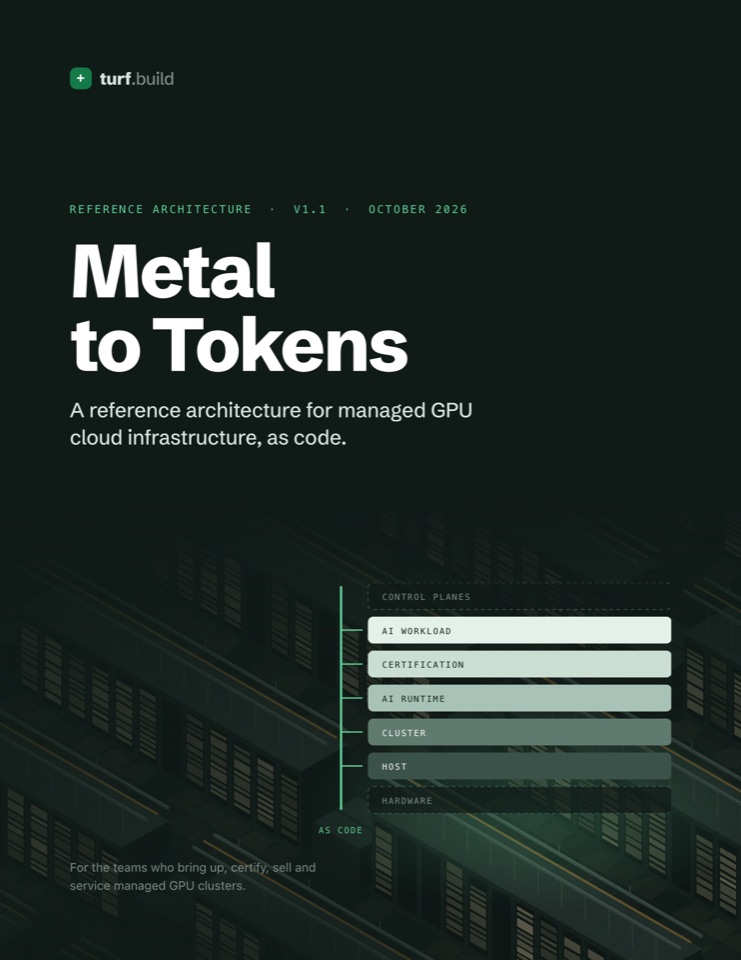
Reference architecture · v1.1 · October 2026
A reference architecture for managed GPU cloud infrastructure, as code. Turf™ is cluster orchestration software for neocloud providers, built on OpenTofu™.
The managed cluster
A neocloud doesn’t sell GPUs by the hour. It sells a managed cluster: qualified before handover, current on drivers and firmware, the same on every node, and back in service soon after a fault.
That is what the market grades. SemiAnalysis’s ClusterMAX 3.0 rates GPU clouds on the operating discipline above the hardware, and it sets the bar in two sentences: “Handling a failure takes two things: Identify it happened. Fix it properly.”
Today that discipline is spread across tools. Terraform® for the cloud API. Ansible® for the hosts and devices. Helm® for the runtime. Scripts for burn-in. A runbook in a wiki, and a person on call to stitch them together.
One convergence loop brings up the whole managed cluster, from the metal to the tokens, NVCRE certification included. Every change, from a person or an agent, arrives as a change plan that is checked and approved before it runs. Turf deploys the stack and then services it, across a fleet of clusters.
Turf builds and operates managed clusters in three ways.
The managed cluster is one body of Terraform code: the provider’s whole stack, from the hardware pool to the tenant’s agent. Terraform resources are the desired state at every layer. Terraform actions are the steps between them: run the host playbook, wait for the GPU census. One change plan covers all of it. → Chapters 7 and 12.
The health checks find the fault. What happens next is the provider’s remediation runbook, and the agent follows it. Each step is a change plan, approved by policy or a person and carried out by the engine, with the agent overseeing. → Chapters 10 and 11.
Turf plans what it can know, applies it, and plans again. Every round’s change plan is checked and approved before it runs. Then the engine reports the outcome, and the outputs, to the agent and the provider’s control plane. → Chapter 8.
The paper walks the cluster stack three times. Part I zooms in, one layer at a time. Part II zooms out to the convergence loop. Part III zooms out again, to day-2 across the data center.
Twelve chapters in three parts, a page on the Turf engine, and the stacks to run.
Turf is available now, as a download. No form, no login. Free for noncommercial use. Commercial use, including a company’s internal use, requires a license; companies evaluate Turf under a free pilot. The stacks in this paper are in github.com/turfbuild/turf-examples.
Get started Licensing Read the PDF
Also from Turf: Pull Request to Production, a reference architecture for Terraform delivery on GitHub Agentic Workflows, for platform engineers who run Terraform through CI/CD.
NVIDIA and NVCRE are trademarks or product names of NVIDIA Corporation, referred to here only to describe interoperability. Turf is not affiliated with, endorsed by, or sponsored by NVIDIA. ClusterMAX is SemiAnalysis’s rating of GPU clouds. Quotations are from ClusterMAX 3.0 (September 2026) and are attributed. Turf has no relationship with SemiAnalysis, and nothing here implies a rating. All other marks belong to their owners.