Use cases
Turf™ is one engine for the whole stack: hosts, clusters, charts, playbooks and the workload in the Terraform® language, planned as one and converged in rounds. Five ways teams put it to work, each with its day 1 and its day 2.
01 · Neocloud providers
A neocloud sells a managed cluster, not GPUs by the hour: qualified before handover, current on drivers and firmware, back in service soon after a fault. Turf brings the whole managed cluster up in one convergence loop, certification included, and services it on the provider’s runbook.
Every layer is code, brought up by one convergence loop. The decision layer, the provider’s agent, runbook and policy, approves each change plan and oversees remediation.
resource "kubernetes_manifest" "certification" { manifest = { apiVersion = "nvcre.nvidia.com/v1alpha1" kind = "Certification" spec = local.spec } lifecycle { action_trigger { events = [before_create] actions = [action.kubewait_condition.gpu_census] } action_trigger { events = [after_create] actions = [action.kubewait_condition.certification_complete] on_failure = taint } } }
The provider offers hardware as a pool; Turf starts where the pool hands over a machine. The host playbook runs as a Terraform action, the cluster comes up, the AI runtime installs as the rendered recipe, and the certification runs as a resource with the GPU census before it and the wait after. One change plan covers all of it, approved by policy or a person, round by round, until nothing is left to defer.
The health checks find the fault. What happens next is the provider’s remediation runbook, and the agent follows it: cordon and drain, repair or replace, re-certify, uncordon and return, each step a change plan the engine carries out. A recipe upgrade re-fires the certification under the same approval, and a fleet is many stacks from a few golden recipes.
coming soon A preview of the Turf console: the AI runtime applying in round 2, paused at the certify step. Click to enlarge.
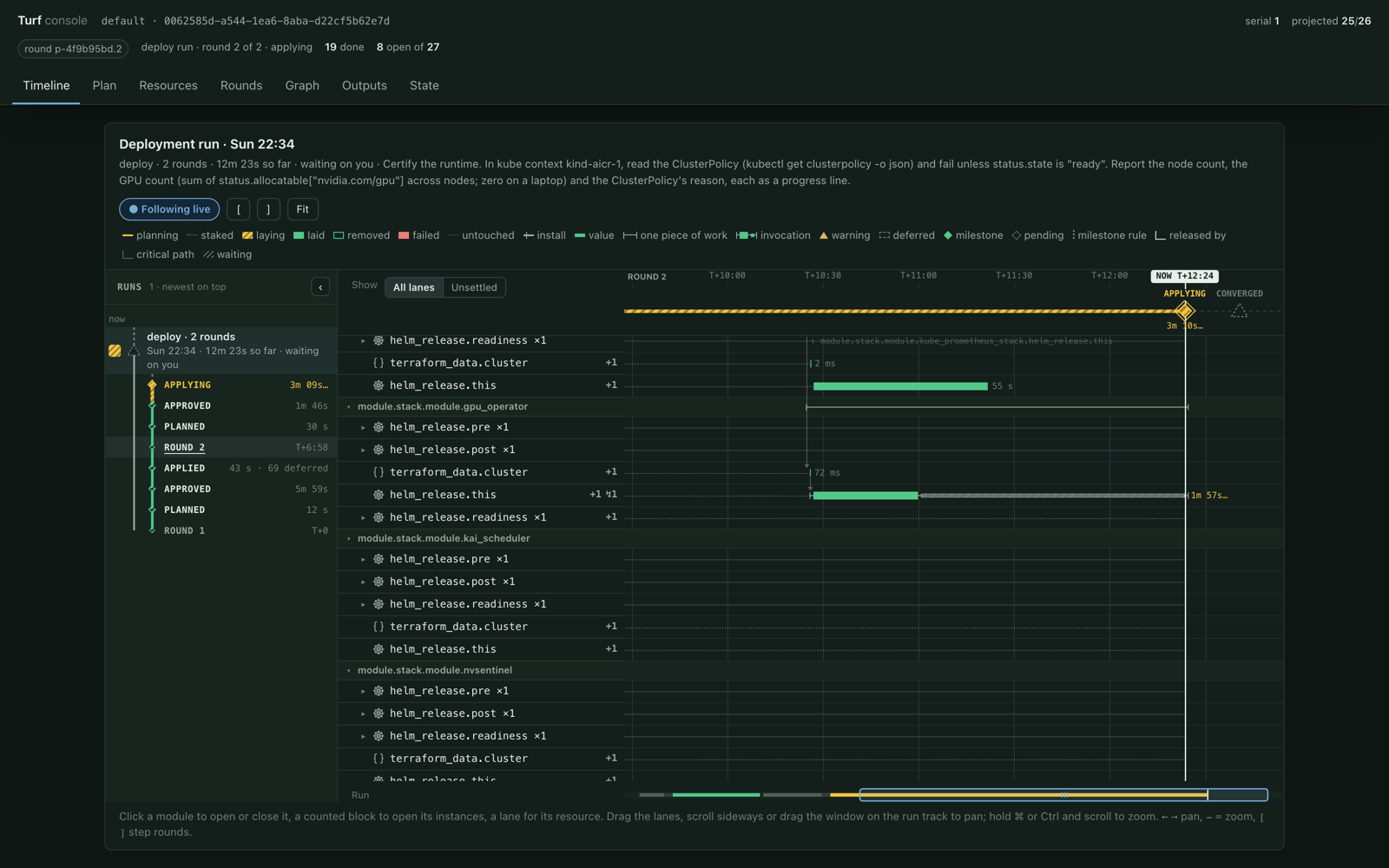
A preview of the Turf console: the AI runtime applying in round 2, paused at the certify step. Click to enlarge.
Metal to Tokens walks the cluster stack three times: one layer at a time, then the convergence loop, then day 2 across the data center. Seventeen pages, free, with the stacks on GitHub.
02 · SaaS and platform providers
A control plane, a golden recipe, and a fleet of Kubernetes® clusters that each deliver your service to a tenant. Turf runs in the cluster beside them: a tenant’s cluster is one module call, a change arrives as a pull request or an MCP call, and every cluster is its own stack under approval.
module "tenant_acme" { source = "registry.example.com/platform/gpu-cluster/kubernetes" version = "2.4.0" tenant = "acme" recipe = "h100-inference" gpu_nodes = 16 } output "acme" { value = module.tenant_acme.endpoints # read back by the control plane }
A tenant order, in the data center. Each block is a tenant cluster, and the green ones have a run in flight.
The control plane writes the tenant’s cluster as HCL and opens a pull request, or calls Turf’s
MCP server directly: open, up, plan, apply, output.
Either way the change is a plan, approved before it runs, and the outputs come back to the
control plane when the run converges. Turf runs in Kubernetes, deployed as an agent,
with its state in the cluster.
Bump the recipe version and every cluster plans its own change; routine changes are approved by policy, the rest by a person. Drift is found on every plan. Replacing a cluster plans the orderly teardown of what it hosted instead of letting it vanish with the machine, and a run that is interrupted picks up where it stopped.
03 · ISVs and AI-native products
Your product ships a reference architecture; the customer gets a forty-page deployment guide and a solutions engineer. Make the installer part of the product instead: the architecture as Terraform modules, planned in the customer’s account before anything exists, with the installer’s own steps written in as turf actions.
The installer is code too. The product ships its architecture and its own steps; Turf plans in the customer's account with no credentials, the customer approves, and the loop creates identity, compute, network and storage until the app is up.
The reference architecture is Terraform modules the product ships. In the customer’s account Turf plans it from empty, the customer approves, and the apply runs with the installer’s steps inside it: verify the storage is private, send the welcome when the app is usable. Any mix of HCL and natural language: the modules carry the architecture, the customer’s specifics arrive as variables or as a sentence.
A new version of the product is a new plan in the customer’s account. Drift is detected on
every plan and healed by the same loop. Nothing that holds the customer’s data is removed
without their word, because consent is bound before its destroy. The product
drives Turf over MCP, the same interface Claude Code uses, and runs where the product runs:
embedded, in a container, in the cluster, on a local model.
04 · Teams adopting agents
Turf is an MCP server at its core: the tools and the skills an agent needs to take a sentence to a running stack and to operate it afterwards, with the plan as the contract between them. Designed for efficient reasoning models such as Claude Sonnet 5.5: the skills carry the procedure, the results carry the summary, and the model carries the judgment.
The same agent, with a shell or with Turf. The engine carries it out; the agent oversees, and every step leaves a record.
import { to = aws_s3_bucket.raw id = "acme-raw-data" } resource "aws_s3_bucket" "raw" { bucket = "acme-raw-data" }
plan plans it, refresh and replace
chosen there, and stops at its approval point with the plan's summary.apply with the plan's digest is the
approval, of that plan and no other; apply with decline turns it down,
and cancel ends the run. Nothing is approved in advance.show returns the plan as
OpenTofu's own document: input.tfplan for OPA, conftest or Checkov, or your
platform's policy groups, before a non-trivial plan is approved. A plan-only run keeps its plan
as a planfile, for another server, with its own credentials, to apply.taint marks a replacement for
the next plan; workspaces listed and deleted.list and query,
for import at scale.coming soonThe agent finds the provider, reads the schema it will write against, and writes ordinary
Terraform files you can read, commit and run anywhere. up starts the run,
plan plans the whole directory and stops at the approval point with the plan’s
summary; you approve from Claude
Code, Cursor, Codex or any MCP client, on the subscription you already have, and the
engine carries it out.
What was clicked together comes in through import. Drift shows on every plan. A declared action
runs on demand with its own approval point. The guardrails example scans every provider
before it runs, pins the workload to a commit and checks every plan against policy before it is
approved. Local models and private GPU clouds: intent never has to leave your network.
05 · Platform engineers
The pipeline you have plans at pull_request, applies at push, and
applies with -auto-approve: the plan the reviewer saw is not the plan that runs,
and nobody reads the one that does. Put an agent in the pipeline, with Turf on the runner as
its engine. It reads the plan, judges it by your policy in plain language, checks the providers
against GitHub’s Advisory Database, applies the reviewed plan and no other, verifies from
inside the apply, and promotes by GitHub Environment. Turf™ is an autonomous
infrastructure-as-code tool for agentic workflows, built on OpenTofu™.
Every stop attended. GitHub Agentic Workflows run the agent as an Actions job; Turf’s server and engine run on the same runner, with the cloud credentials in their process and never in the agent’s. The Environment supplies the variables, the role and the policy.
## staging Approve any plan, including replacements and deletes, except one that would: - destroy the shared execution role (aws_iam_role.lambda_exec), or - delete every function in the fleet. ## production Approve only a plan made of creates and in-place updates: no replacement, no delete of any kind, including a shrink of the fleet. Any other plan is refused: report it with the rule that refused it, say that a person has to run the apply for this environment by hand, cancel the convergence, and apply nothing.
TURF PLAN · PULL REQUEST #5 · THE DIFF BLOCKPlan: 2 to add, 2 to change, 2 to destroy (2 replaced) ∓ aws_iam_role.lambda_exec (replaced: name) name: …-staging-exec → …-staging-lambda-exec ∓ aws_iam_role_policy_attachment.lambda_policy (replaced: role) ~ aws_lambda_function.hello[0] role: …/turf-hello-staging-exec → (known after apply) ~ aws_lambda_function.hello[1] role: …/turf-hello-staging-exec → (known after apply) Verdict: refuse · the convergence cancelled, the lock released
Refused under the staging approval rule (policy/approval.md): the plan would
destroy the shared execution role aws_iam_role.lambda_exec. Its name changes
from turf-hello-staging-exec to turf-hello-staging-lambda-exec,
which forces a replacement. The policy attachment is replaced and both functions are
updated to the new role. The plan is 2 to add, 2 to change, 2 to destroy. The providers
rule passed (no advisories). A person needs to review and apply this change by hand, or
keep the existing role name.
REQUEST_CHANGES · from run 41238948486, 2026-10-31
The plan workflow runs on every pull request that touches the configuration. The agent
checks the providers, reads the plan Turf made, judges it by the staging policy, and posts one
comment: the providers table, the plan as a diff, the verdict with the policy that decided,
and the plan as data at the foot. Its review is a COMMENT when the plan is
ready, REQUEST_CHANGES when the policy refused. Then it cancels the
convergence: a plan run holds nothing.
The merge starts the staging apply. It plans again, compares with the reviewed plan, and
approves that exact plan. The apply pauses at the verify turf action; the agent
fetches every function URL with curl and reports back, and the engine converges. A label on
the pull request lets production start: the same configuration, the production
Environment’s role, state key and fleet, and a stricter policy. A failed verify halts the
apply, withholds the label, and the agent opens the fix: a limited rollback as a pull
request, never a wholesale revert, since a moved block or an upgrade has
already happened.
NVIDIA, AI Cluster Runtime, NVCRE, NVSentinel and KAI Scheduler are trademarks or product names of NVIDIA Corporation, referred to here only to describe interoperability. Amazon EKS, Amazon S3, Google Kubernetes Engine, Google Cloud Storage, Azure Kubernetes Service and Azure Blob Storage are trademarks of their respective owners. GitHub, GitLab, JFrog Artifactory, HashiCorp Vault, Scalr and Spacelift are trademarks of their respective owners, named here only to describe interoperability. GitHub Actions and GitHub Agentic Workflows are trademarks of GitHub, Inc. AWS and AWS Lambda are trademarks of Amazon.com, Inc. or its affiliates. Claude is a trademark of Anthropic, PBC. Turf is not affiliated with, endorsed by, or sponsored by any of them. All other marks belong to their owners.
Commercial use, including a company’s internal use, requires a license. Companies evaluate Turf under a free 60-day pilot on a standard contract you can read in full: the same binary everyone downloads, a direct support channel for the pilot, and no license key. The teams that pilot early shape what comes next.